Textile · GM-001
The Gurriers’ Arms T-shirt
“I went to The Gurriers’ Arms and all I got was hepatitis.”
Pub black with medicinal-yellow lettering. Sizes: Regrettable, More Regrettable and Consultant’s Fit.
€26.00Imaginary stock
Shop and Cop Shop · Ballymagaleen
Looking for the perfect present? The perfect past never was. A better future is not presently in stock.
Open whenever the Sergeant is not elsewhere

Sgt Bod Gombeeni, proprietor, peace officer and sole witness to the stocktake
By appointment to nobody
Gombeeni’s supplies Ballymagaleen with books, devotional miscellanea, commemorative textiles and objects which may once have been evidence. The shop shares premises, staff and filing deficiencies with the Garda station.
The merchandise below does not, strictly speaking, exist. This has never prevented it from being counted, insured or advertised as the ideal gift for the person who has everything and ought to return some of it.
Parish goods & confiscations
Prices include VAT, folklore and a small contribution to the Sergeant’s Christmas do.
Textile · GM-001
“I went to The Gurriers’ Arms and all I got was hepatitis.”
Pub black with medicinal-yellow lettering. Sizes: Regrettable, More Regrettable and Consultant’s Fit.
Crockery · GM-014
Sgt Gombeeni’s official incident-response vessel.
Holds tea, instant coffee or a statement pending clarification. Handle supplied on the right unless reversed.
Hydration · GM-022
“May contain Trout of Doubt.”
Locally bottled at source or nearby. Not guaranteed potable, miraculous, epistemologically clarifying or free of opinions.
Hospitality · GM-031
“Break seal in case of metaphor.”
A discreet six-ounce intervention for recitals exceeding twenty minutes. Arrives empty out of respect for licensing law.
Domestic · GM-044
“Elevation: disputed. Scale: 1:10,000 temperamentally.”
Shows the peninsula at low tide and high confidence. Absorbency has been alleged but not admitted.
Finance · GM-050
“Your deposits are safe somewhere.”
Ethically unbleached canvas with reinforced moral hazard. Suitable for groceries, prospectuses and light capital flight.
Culture · GM-061
“No Terns Left Unstoned.”
A regrettable slogan embroidered with public money. No seabirds were harmed, consulted or properly represented.
Provenance · GM-099
“Chain of custody sold separately.”
Insulated, wipe-clean and pre-labelled “Property of Sgt Gombeeni”. Contents liable to become relevant without warning.
Books kept behind the counter
Unlike the merchandise, the books are real. This has caused some disappointment.
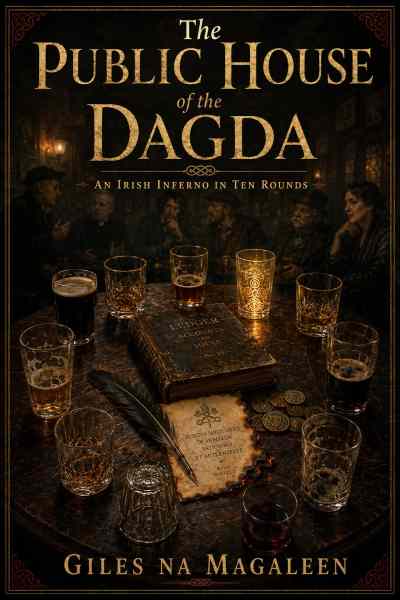
Irish inferno
A comic descent beneath Ballymagaleen in ten rounds, where Ireland’s dead, immortal, clerical and merely thirsty dispute the minutes.
Cultural criticism
Alienation, iconography and the aesthetic life of lost functions: why form grows most decorative just as purpose retreats.
Moral reflection
Not self-help, but moral reflection for grown-ups: an inquiry into love after appetite, vanity and the modern sales department have had their say.
A practical impractical guide
Creatureliness, courage, mortality and the difficult business of remaining human while everyone else is improving the metrics.
Mock scripture
Codex Cohensis: a comic apocryphon of partners, ledgers, transmission, belief and the final auditor’s report.
Historical adventure
Roderick na Magaleen crosses Muscat, Zanzibar and the Seychelles as the Great Game collides with spies, pearls and Irish fieldcraft.
Historical comic novel
Unsettled loyalties, adjustable doctrine and a hero with a remarkable instinct for being useful to the latest power through the door.
Religion & digital culture
Augustine’s two cities reconsidered for the digital age: belief, accusation, moral panic and the communities formed through screens.
See current editions, formats and availability on Giles na Magaleen’s Amazon author page.
Visit the Amazon bookshopThe parish record · unabridged

Looking for the perfect present? The perfect past never was. A better future, not a perfect one-
There are books which ask to be read, books which demand to be reviewed, and books which burst through the vestry door with a dog, a grievance, a Latin tag and three dead statesmen demanding amendment of the minutes. The Public House of the Dagda belongs, magnificently, to the last category.
Presented as An Irish Inferno in Ten Rounds, Giles na Magaleen’s latest misadventure descends beneath Ballymagaleen, that unmappable Atlantic parish where geography has given up and theology is still arguing with the tide. Under St Simon Stockholder’s Priory lies the only drinking establishment adequate to Irish history: the Public House of the Dagda, where the dead, the immortal, the clerical, the political, the mythic, the literary, the wounded, the self-wounding and the merely thirsty assemble to contradict one another until metaphysics buys the next round.
This is not a polite book. It is a house-session of the national soul. Dante is invited, mislaid, improved upon, and then sensibly watched by a Púca. Archbishop McQuaid appears as a purgatorial presence of terrible administrative polish. Sally O’Brien refuses to become an allegory, which is perhaps the most heavenly act available to any woman in Irish letters. Joyce, Emmet, Collins, de Valera, Medb, Brigid, publicans, poets, bishops, dogs, widows, barristers and doctrinally unstable archivists all jostle in a room where no argument is dead merely because all the participants are.
Giles writes with the swagger of a decayed aristocrat who has read too much, drunk just enough, and concluded that history is what happens when memory is left too long in a damp parish hall. The sentences are baroque, bruising, funny, over-educated, under-supervised and frequently dangerous near naked flame. Yet beneath the laughter is a real moral unease: who gets to judge Ireland, who profits from her wounds, who mistakes grievance for identity, and whether any country can be loved without being declared innocent.
The Public House of the Dagda is a comic inferno, a theological pub crawl, a literary ambush, and a formal complaint against solemnity. It is also, happily, the rare Irish book that knows every grand theory of the nation must eventually answer to a publican, a dog, and a woman with better judgement. It should be read by anyone who suspects that the Irish afterlife will have poor signage, excellent drink, disputed seating, and a woman in the corner who knew the answer before the men had finished the question.
https://www.amazon.com.au/dp/B0H2V7L73B
By: Rev. Patrick I. Pointer, STL
Senior Fellow in Ecclesiastical Pedagogy and Epistemological Metrics The Peninsula Institute for Society, Science, Technology, Arts and Knowledge Erosion (PISSTAKE)
It is a foundational principle of our work here at the Peninsula Institute that true knowledge expansion must never be confused with the mere industrial accumulation of digital data. It is therefore with a sense of profound, almost sacramental relief that I have spent the last few days inside the pages of Giles na Magaleen’s extraordinary new monograph, The Ornament of Distance: Alienation, Iconography, and the Aesthetic Life of Lost Functions, freshly issued under the crisp, Wyoming-based imprimatur of Paddy2021 LLC. For those of us weary of the modern educational bureaucracy, na Magaleen’s work arrives not merely as a book, but as an elegant, unsparing declaration of intellectual war.
Na Magaleen begins his volume by laying down an immutable axiom that deserves to be engraved above the mantelpiece of every faculty lounge and dean’s office in Christendom: “the further from the function, the greater the aestheticisation of the form”. With the characteristic provincial wit that has come to define the author's voice, he notes that a spade that digs requires no self-congratulatory announcement of its values, and a sturdy kitchen table has no need to issue a corporate mission statement. A true parish church, he reminds us, can easily survive a mediocre choir and an unambitious carpet, provided the liturgy still means something—and provided the pulpit remains free from the superficial ramblings of an over-groomed curate who thinks grace is merely a software upgrade.
The trouble with our late-modern landscape, as na Magaleen brilliantly diagnoses, is that where reality retreats, the image comes running in with perfume, powder, and a ring-light. We have entered a world where institutions, products, and human selves have become intensely decorative precisely because they have lost all confidence in their original ends.
As a reviewer, I was particularly struck by the sheer, panoramic ambition of the book’s architecture. Na Magaleen tracks this flight from function across what he calls the "illuminated sewage works of modernity". He carries the reader with fluid ease from a historical philology of the "pornographic gaze" into a devastating anatomy of the contemporary "platform self". No cultural pathology escapes his gaze: the transactional, mirror-gazing desperation of "looksmaxxing" cultures; the manufactured intimacy of the podcasting "bro-caster"; and the counterfeit charisma of Silicon Valley’s founder-messianism, where figures like Elizabeth Holmes and Sam Bankman-Fried hid their systemic vacuity behind iconographic black turtlenecks, calculated anti-style, and shiny new things that no one else was allegedly smart enough to understand.
For those of us at the Institute tasked with evaluating pedagogy, na Magaleen’s chapters on "Classification, Credentials, and the Predictive Self" offer a timely and bracing rebuke. He warns against the modern "assessment culture" that seeks to benchmark, type, profile, and forecast every human movement. This bureaucratic fantasy converts the open, unpredictable horizon of the human soul into a mere "trajectory" or an aggregated public score. In doing so, it trades genuine formation for mere platform "following", resulting in a university prospectus that is infinitely more coherent than the actual curriculum being taught.
Yet, the genius of The Ornament of Distance is that it refuses to terminate in fashionable, Parisian despair. Beneath the author’s sharp, melancholic observations lies a stubborn, joyful hope. In the book’s magnificent conclusion, na Magaleen points the reader toward a recovered horizon of "creatureliness, gift, and received being". The self, he argues, is rescued from total objectification not through another commercialised "makeover", but through the quiet, costly art of remaining present to one another in time and space—through local loyalty, honest craft, the keeping of graves, and the restorative discipline of the Sabbath.
In sum, Giles na Magaleen has written a work of exceptional gravity, metaphysics, and necessary laughter. It is an indispensable guide for anyone seeking to remove their borrowed spectacles, pour something decent, and remember what human life is actually for. PISSTAKE gives it our highest, un-metricized recommendation.

The author, briefly detained
Giles na Magaleen is a writer, philologist and unreliable custodian of the Ballymagaleen inheritance. From Cashelmagaleen House, on an Atlantic peninsula whose attachment to the mainland is intermittent, he writes comic novels, mock scripture and serious essays about belief, language, institutions and the elaborate means by which people organise confusion.
Educated in comparative philology, he later pursued applied linguistics, banking and ritual—disciplines he regards as separate chiefly for administrative purposes. His intellectual company includes Dante, Sterne, Thackeray, Flann O’Brien and Simone Weil, together with the anonymous hands responsible for the best marginal notes in old books.
Beneath the comedy lies a persistent concern with attention, dignity and community: how people live together before systems begin speaking on their behalf. Giles prefers monks to bishops, dogs to committees, and a well-made footnote to most forms of public statement.
“History is what remains after the minutes have been corrected by the victors and annotated by the publican.”
No imaginary merchandise is sold through this page and no payment details are collected. To acquire an item, present yourself at Gombeeni’s with cash of an imaginative denomination. Books are real and may be bought from Amazon. Returns are accepted only with the original grievance, two witnesses and a note from Fr Sebastian.