The Cellar Manuscripts
The Coarse of Irish History
A dispatch from Cashelmagaleen in its unabridged and mildly incriminating form.
The parish record · unabridged
The manuscript in full
The Coarse of Irish History
The Cause of Irish History
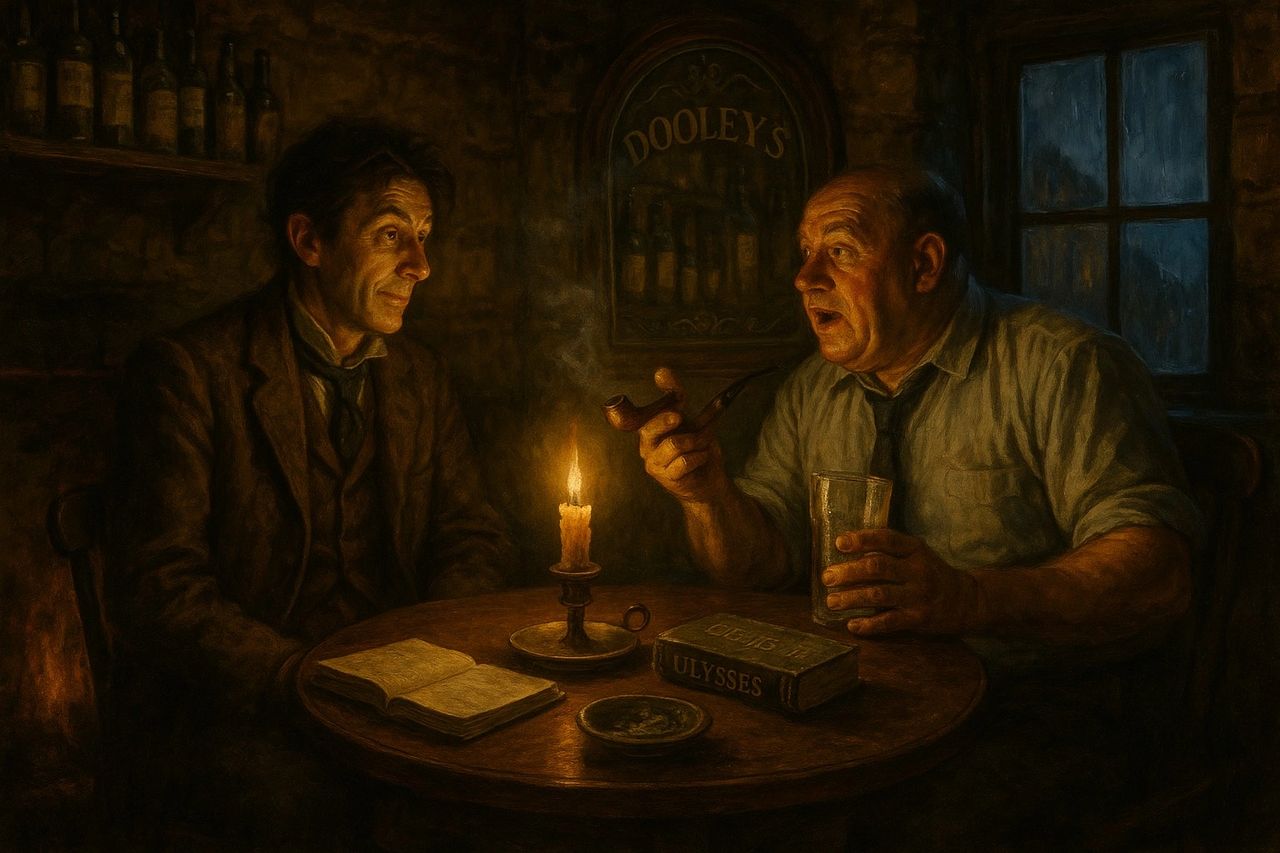
(Being a memoir of a conversation in Dooley’s snug, as remembered by Giles na Magaleen)
There are moments in the national life when History itself gets drunk and has to be put to bed. One such moment occurred, to my knowledge, in the snug of Dooley’s some indeterminate hour after lawful closing, when Sergeant Bod Gombeeni undertook to instruct me in what he termed “The Coarse of Irish History.”
The snug, at that hour, resembled the afterlife described by the early Fathers—dimly illumined, full of smoke, and attended by souls unwilling to confess. A single candle guttered in a saucer of Powers whiskey, the air sweet with turf and sin. Dooley herself had long since retired to the arms of restorative oblivion, leaving us to theological and historical matters.
“Here Vi go again,” the Sergeant began, lifting his pint in a gesture that seemed half-ritual, half-warning.
“Vi?” I inquired.
“Victoria, the oul’ wan herself. Every time the country starts doin’ rightly, she sends another generation of Englishmen to ruin it. We’ve been on the same roundabout since the flood—Vi here, Vi there, Vi everywhere. That’s the Cause of it, lad: round and round like a hurley or a woman’s reasoning. Here Vi co again!”
I ventured to suggest that such cyclical recurrence might be modelled mathematically, but he waved the notion aside with his pipe.
“Mathematics? Jaysus no. It’s mollycúls, Giles, mollycúls all the way down. History’s made of them—tiny little bits of language bangin’ together. You get your mac tíre crashin’ into your tóin, and before you know it you’ve a revolution on your hands.”
I was uncertain whether he meant this as physics or as poetry, but he pressed on.
“The mollycúl theory explains the lot. Every time a new word’s invented, another fella dies for Ireland. Language, that’s the real gunpowder.”
He leaned close, conspiratorial.
“An’ because of them mollycúls, all the writers end up kissin’ James Joyce’s Royal Irish Arse. They can’t help it, poor bastards—the attraction’s molecular. Even the priests’ll tell ye it’s gravitational.”
At this I felt obliged to record my own contrary aspiration: that one day every Irishman might possess an Imperial Arse, properly upholstered, upon which the Mountbatten-Windsors might perform acts of intergluteal osculation as homage, in token of historical reconciliation. The Sergeant approved.
“Fine idea,” he said. “But we’ll have to license it. Can’t have every eejit rentin’ out his posterior to the tourist trade. You’d need a stamp from the Department of Heritage.”
He refilled our glasses from a bottle that had appeared, by miracle or muscle-memory, from beneath the bench.
“Now,” he said, “about the romance. The land herself is to blame. She breathes it into the people, like a damp wind. That’s why we keep fallin’ for republican chancers—the Son of the Land, the oul’ faol, your tóin, the Feeny Annes with their flags an’ fiddle tunes.”
He counted them off on his fingers, each nail bitten to the quick.
“The Anglo-Irishman Pearse—squints like he’s lookin’ into the sun of his own martyrdom. The Scotchman Con O’Lee, the Armorican Dave O’Laoighre, an’ don’t forget the women an’ Childers. All of them lovely dreamers with dynamite in their drawers.”
I confess I began to feel the proud and desperate heat of patriotism rise in me, but the Sergeant doused it with professional efficiency.
“Romance, lad—that’s the first step to treason. Ireland doesn’t need more lovers; she needs an accountant with a whip. Till then, the Cúrse goes on.”
He drew a long drag from his pipe, exhaled history itself, and looked at me with the calm of a man who has arrested his own illusions.
“Still,” he said softly, “I wouldn’t live anywhere else. Where else would a fella get paid to believe in ghosts an’ call it community policin’?”
Outside, the dawn was assembling itself from mist and birdsong. The candle died, the Powers evaporated, and the mollycúls of Irish history dispersed once more into the ether.
I left the snug with the Sergeant’s theory echoing in my skull like a bodhrán in a bucket. Perhaps he was right. Perhaps all our revolutions are merely the same sentence rearranged, the same faol tóin chasing its own cúl through the centuries.
Either way, I resolved to write it down, before sobriety set in and the atoms of sense fled the scene.
— From the journals of Giles na Magaleen, Cashelmagaleen House, Ballymagaleen
Share this post: