The Cellar Manuscripts
Time for the Time Team
A dispatch from Cashelmagaleen in its unabridged and mildly incriminating form.
The parish record · unabridged
The manuscript in full
Time for the Time Team
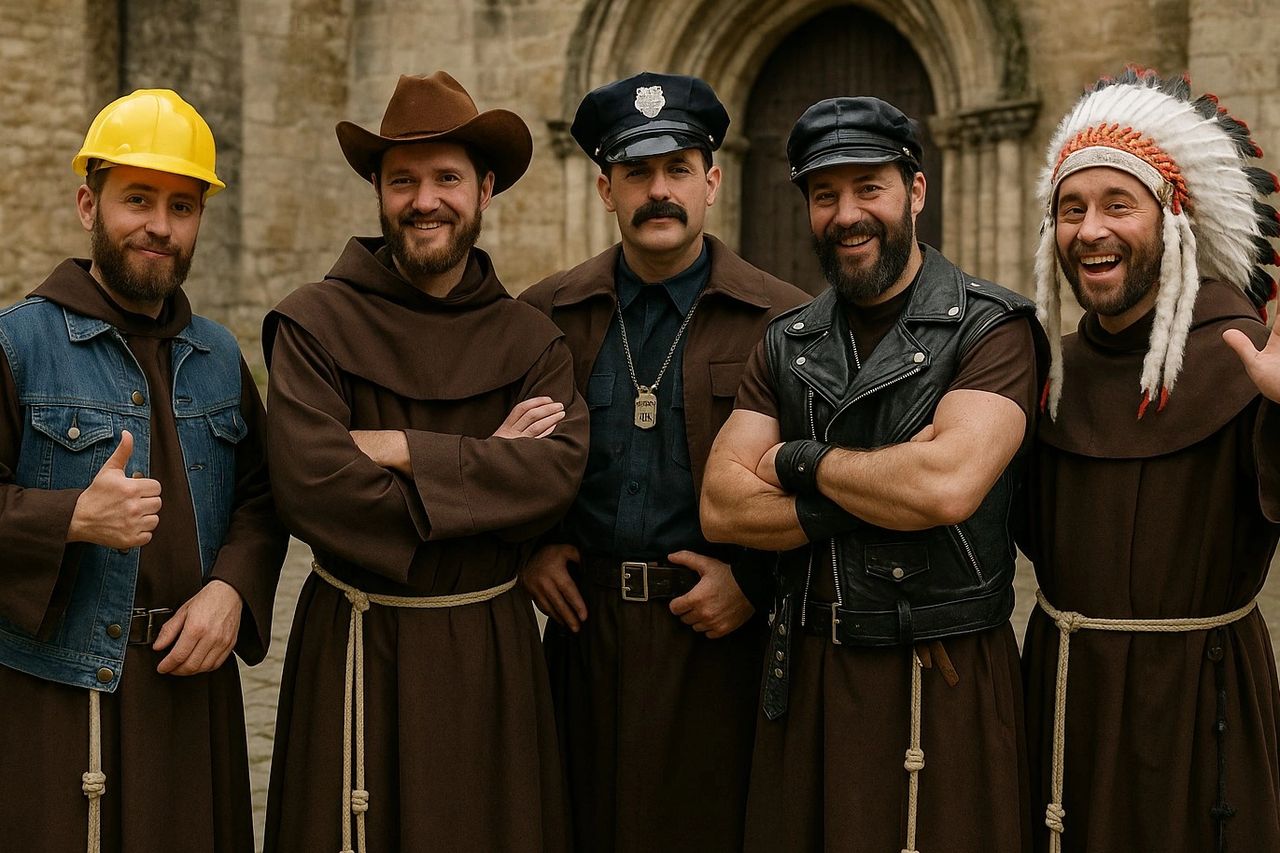
By Friday teatime the peninsula had filled up with white vans. They came nosing along the boreen like a convoy of suspicious sheep: production truck, sound truck, generator truck, a van labelled GeoPhys that looked like it had escaped from a low-budget Bond film, and finally a little people-carrier out of which sprang Tony Robinson, as if fired from a catapult of enthusiasm and BBC residuals.
I had, against my better judgement, granted them access to the ruins of St Simon Stockholder’s Carmelite priory. The producers had promised “minimal disruption,” which in televisual terms means only three days of chaos, fifteen people with clipboards, and a drone.
Tony shook my hand as if I were a minor Plantagenet whose rights he intended to explain away in a voice-over.
“Giles na Magaleen! Our local historian, landowner and… what was it?”
“Philologist,” I said. “And part-time liturgical apologist for architectural obscenities.”
He blinked. The assistant producer made a little note that I later discovered read: Don’t let him say “obscenities” on camera.
The plan was simple. In three days they would “unlock the secrets of the cloister.” I had been trying to unlock those secrets for years. Not, I hasten to add, with a trowel. The old priory is honeycombed with holes – neat, round, deliberate apertures through walls that had no earthly need of aperturing. I had long suspected that certain of the Whitefriars had found ways of reconciling the rigours of the Rule with the rigours of the flesh.
In short: glory holes. Fenestrae gloriae, as I have suggested in my more learned moments, to the horror of every decent Latinist and the fascination of every indecent one.
Saturday morning the trenches went in. Phil the archaeologist and his team advanced on the cloister garth like particularly earnest moles. Ground-penetrating radar beeped, cameras whirred, and Tony trotted from pit to pit narrating, while I hovered like a disreputable benefactor, sipping coffee from Dooley’s thermos and wondering when the entertainment would start.
It didn’t take long. One of the younger archaeologists – a nice girl from somewhere that did not have turf – lifted a bramble and called out:
“Tony! We’ve got something unusual in the cloister wall.”
There it was. A perfect circle, wrist-wide, cleanly cut through two feet of medieval masonry at approximately what one might call a convivial standing height. On the opposite side, the remains of a now-vanished corridor. I watched the mental gymnastics ripple down the trench.
“Well,” said Phil, kneeling, “this could be… ventilation.”
“For what?” I asked. “Monastic draughts?”
“Candle smoke, perhaps. Or a speaking tube. Medieval communication device.”
“Indeed,” I said. “They certainly communicated.”
Another hole turned up six feet along. Same height, same diameter, same implausible innocence. Then a third, blessed be the pattern. One did not need a PhD; one needed only a rudimentary acquaintance with human ingenuity and the more spirited commentaries on the Rule of St Albert of Jerusalem.
The camera turned on me.
“So, Giles,” Tony said, doing his best “tell us in layman’s terms,” “what do you think these are?”
“I think,” I said, “that we are looking at the material remains of an advanced late-medieval technology of discreet interpersonal devotion.”
Phil coughed. The sound recordist snorted. The assistant producer made a slicing motion across her throat.
“We are,” I continued sweetly, “in the presence of what, in certain specialised traditions, might be called glory holes.”
Silence. A gull laughed overhead. Somewhere behind the camera someone dropped a clipboard.
“Of course,” I added, “glory in the Pauline sense. Non nobis, Domine, but nevertheless through us.”
The rest of the morning was a valiant exercise in archaeological euphemism. On camera, the holes became “oculi,” then “service apertures,” then “liturgical niches.” Off camera, over sandwiches, they were “those bloody things” and “absolutely not what you said, Giles.” Phil floated a theory about food being passed through to anchorites. Someone else suggested pipes. Pipes! In a 14th-century Carmelite priory that barely managed drains.
By late afternoon, as the rain came in horizontally off the bay, they had a working hypothesis: the priory had once housed a small infirmary, and the holes allowed the brothers to minister to the sick while maintaining a barrier.
“A quarantine measure,” said Phil.
“Of a sort,” I agreed. “Though I suspect the only infection involved was enthusiasm.”
The real fun began that evening in Dooley’s. Tony, the crew, and the diggers squeezed into the snug alongside Sergeant Gombeeni, Father Hitchens, and the ghost of the Reverend Mr Leonard, who had drifted in on a curl of turf smoke to see what the fuss was about.
“So these apertures,” said Fr Hitchens, already two Jamesons ahead of comprehension, “are being solemnly interpreted as medieval sneeze-guards?”
“Far worse,” I replied. “They’re calling them ‘service hatches’.”
The Sergeant wheezed. “Service, is it? I’ll warrant there was service. Sure that wall’s seen more traffic than the N57 on a bank holiday.”
Tony nursed his pint like a man who has seen his fair share of English history and knows when not to ask questions.
“Look,” he said at last, “we’ve got forty-five minutes of telly to make and a compliance department that faints at the word ‘bodkin’. We can’t very well tell the nation we’ve discovered a medieval… whatever-you-called-them.”
“Fenestrae gloriae,” I said. “Windows of glory. I offer the term freely.”
He brightened. “Windows of glory. We might get away with that.”
Sunday was the Big Reveal day. Cameras arranged themselves artfully among the tombstones. Tony did his to-camera piece, standing in front of the cloister wall, the three holes haloed behind him like a row of particularly suggestive stigmata.
“Our team now think,” he declared, “that these unusual openings may have been used so the friars could safely tend the sick or perhaps speak to enclosed worshippers, maintaining both care and separation.”
Behind the monitor, I could see the script on the producer’s clipboard: NO SEX.
“And,” Tony added – bless him, he has a sense of mischief – “local historian Giles na Magaleen has suggested a more… colourful interpretation. But that, I’m afraid, is a story for after the watershed.”
That evening he came up to Cashelmagaleen to sign the inevitable release forms. As he was leaving he turned, looked back toward the dark bulk of St Simon Stockholder’s priory, and said, almost wistfully,
“You really think that’s what they were for?”
“My dear Tony,” I said, “this is Ireland. We invented guilt and improvised plumbing. Give a Celt a wall and a vow of chastity and he will find a workaround.”
He laughed, shook his head, and disappeared into the Ballymagaleen mist with his crew and their innocent documentary. The priory settled back into its customary damp silence, the little round witnesses in its walls gazing out on the cloister like saints’ eyes or keyholes to a better-not-specified heaven.
Glory, as always, is in the opening of the beholder.
Share this post: