1 · Subsidiarity
The person before the parish, the parish before the province and the province before the planet. Decisions belong to the smallest unit competent to make them.
The gospel according to the parish pump
Community before machinery; the person before the parish, the parish before the province, and the province before the planet.
The Gospel According to the Parish Pump supplies the diagnosis; the Partialitarian Manifesto supplies the articles. Together they argue that political responsibility weakens as it retreats into abstraction. A quarrel between neighbours is limited by tomorrow’s encounter. A quarrel conducted in the name of the Nation, the Market or Humanity can forget the human beings for whose sake those names were invented.
Partialitarianism is therefore not a programme for perfecting society. It is a discipline of limits: power near knowledge, duties near consequences, affection near its objects and institutions small enough to hear an objection without commissioning a consultation paper.
Following Simone Weil, attention is treated as a civic virtue and rootedness as a human need. Community is neither a delivery arm of the State nor a market segment; it is the web of obligations formed when people remain close enough to answer for what they do.
The combined doctrine
The person before the parish, the parish before the province and the province before the planet. Decisions belong to the smallest unit competent to make them.
Begin with neighbours, dogs and local saints. Affection, like poitín, grows dangerous when distilled too pure.
Conduct politics within walking distance. The smaller the polity, the harder it is to turn opponents into abstractions.
To be wrong in good humour is holier than to be right under compulsion. Error, incompletion and revision preserve room for freedom.
Uniformity is an aesthetic and political offence. Difference, doubt, dress and dialect require no central permission.
Production should be local, consumption temperate and profit judged partly by whether the bar staff are happy.
The Holy Well is the foreign office and the priory ruins the senate. Divinity is immanent—in the loaf, the trout, the hedge and the mercy shown after last orders.
Every public body should fit inside a moderate-sized pub. Any organisation requiring PowerPoint has already exceeded its natural jurisdiction.
May we never be whole, nor wholly ruled.
The parish record · unabridged
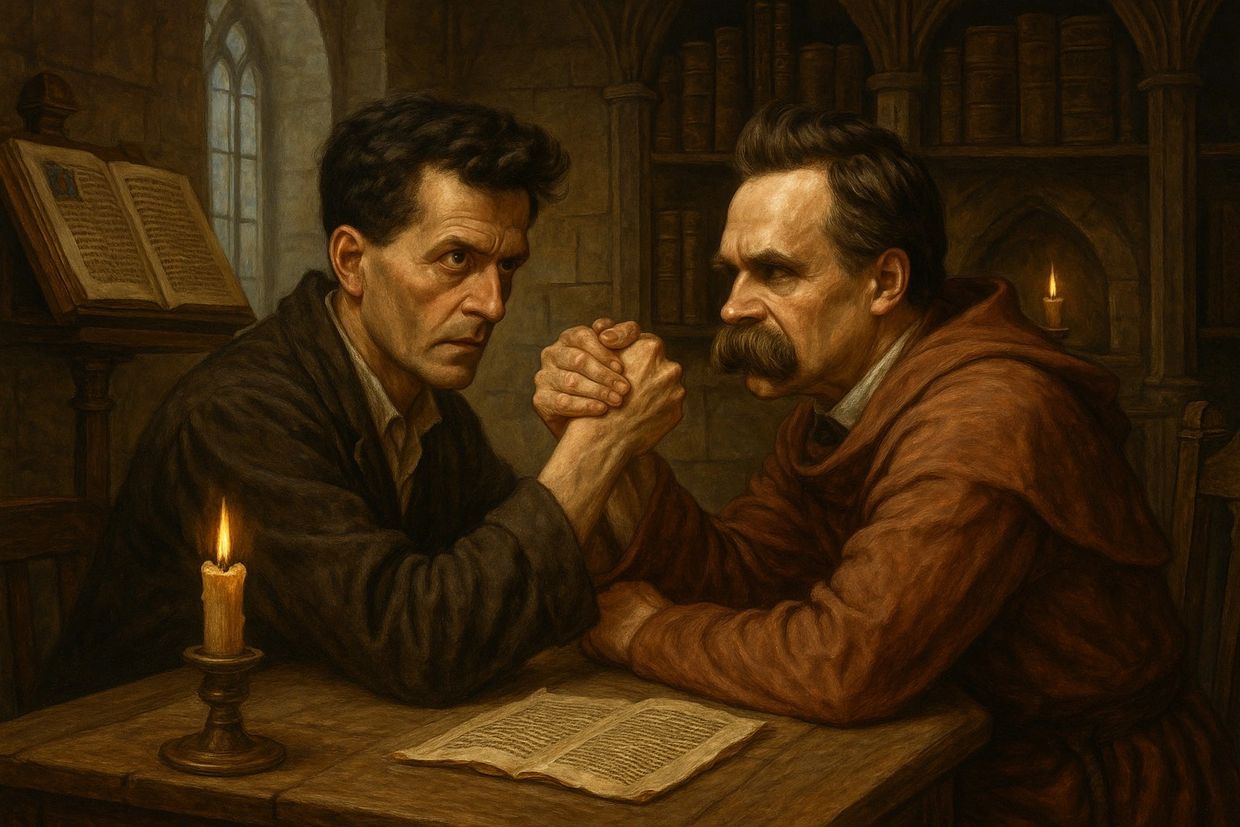
Unity, that supposed virtue of nations, is in truth the hobby of despots and dullards. The larger the banner, the greater the fool who waves it. I stand proudly in favour of Partition — and not merely the historical one that saved Ulster from the tedium of Dublin’s moralising — but of many partitions: domestic, spiritual, and conversational. Every parish should be its own republic, every bar its own parliament, and every family dinner its own secession crisis.
We were Gaels before we were Irish, and the difference is not pedantic but profound. “Irishness” was invented by mapmakers of an English persuasion who could not tolerate the idea of tribes. They preferred a single colour to fill a page. But the world was not meant to be coloured in; it was meant to be argued over.
Man, said Aristotle, is a political animal — which is to say, he cannot resist an argument. Yet there is such a thing as proportion. The Táin Bó Cuailnge was an entire war over a borrowed bull and wounded pride; it left perhaps a hundred corpses and a thousand songs. Compare that to the so-called Great War, with millions of dead and not a single verse worth humming in the snug.
The smaller the polity, the kinder the quarrel. When we fight our neighbours, we must meet their eyes the next day. When we fight abstractions — “The Nation,” “The Market,” “The European Ideal” — we end up slaughtering strangers to prove that strangers matter. Give me the parish pump over Parliament any day; the former leaks, but it still gives water.
There are those who go looking for God in Rome or Canterbury or on the far side of death; I have always found Him loitering nearer home. He hides in the mists over the harbour, in the lowing of cattle, in the glint of a trout before Saint Pierian’s well. I see His blood upon the rose, His body in the loaf of Mrs Dooley’s bread, and His mercy in the forgiveness extended to a drunk who has said too much before last orders.
Meister Eckhart once said — and I paraphrase the good Rhinelander — that it is no use Christ having been born of the Virgin Mary thirteen hundred years ago if He is not being born in us now.
“We are all meant to be mothers of God, for God is always needing to be born.”
(Meister Eckhart, “Sermon 1: The Eternal Birth,” trans. Raymond B. Blakney, 1941.)
If that be true, then divinity is as local as gossip, as immanent as laughter, and as urgent as the next confession.
Patrick Kavanagh understood this perfectly in Epic:
“I have lived in important places, times / When great events were decided: / Who owned that half a rood of rock…”
That half-rood of rock was Ireland’s Ilium, its Waterloo, its Dáil Éireann. Greatness, Kavanagh reminds us, is not measured by acreage but by argument. The pitchforks of Monaghan had more moral force than the armies of Brussels.
So let Ballymagaleen be content in its importance: one parish, two churches, three pubs, and more saints than sinners. Each of us is both electorate and opposition. The village meeting is our senate; the backroom at Dooley’s our upper house.
If we must have a constitution, let it be unwritten, unratified, and largely ignored. Let us live as a republic of small things — trout, turf, talk, and forgiveness. Let the world roar about sovereignty and union while we attend to the divine labour of mending fences and brewing stout.
For the truth is this: heaven was never distant. It has always been immanent, local, a whisper in the hedge or the warmth in a neighbour’s hand. God, like good manners, exists only where men and women remember to practise Him.
So let Ballymagaleen remain divided, gloriously and mercifully so — a confederation of sacred quarrels, held together by laughter, whiskey, and grace.
Giles na Magaleen, DPhil (Disputation), MA (Mischief), DLitt (Lunacy), is the self-appointed Professor of Comparative Inconsequence at the Muldoon Institute of Shrinking Numbers. A Fellow of the Order of Perpetual Digression, he lectures on theology, metaphysics, snipe shooting, and small-engine repair, holding honorary posts in confusion in several European academies.
I'm CuriouserThe parish record · unabridged

By Lord Giles na Magaleen, LL.D. (Dubious), F.R.S.L. (Ret’d)
Cashelmagaleen House, Feast of St Príomhsheans, anno mundi in statu confusionis perpetuae.
Whereas Totalitarianism presumes to perfect the world by flattening it,
Partialitarianism affirms that the world was already perfectly irregular. The
Almighty, in His unfathomable wisdom, created bumps, humps, headlands and
humans — none designed for uniformity. The attempt to make them all square is
the Devil’s own geometry.
The First Principle: Subsidiarity
Power shall reside where the knowledge is brewed — close to the source,
preferably in the snug. Each decision must be taken by the smallest unit competent
to decide it: the person before the parish, the parish before the province, the
province before the planet. Anything larger than a county council is a conspiracy.
The Second Principle: Partial Loyalties
We pledge ourselves not to “Humanity,” that abstract mob, but to our
neighbours, dogs, and local saints. Our patriotism is confined by hedgerows. We
hold that affection, like poitín, grows dangerous when distilled too pure.
The Third Principle: The Blessed Imperfection
Partialitarianism regards error as a sacrament. To be wrong in good humour is
holier than to be right under compulsion. The incomplete, the half-baked, and the
nearly-finished constitute the true vocabulary of freedom.
The Fourth Principle: The Small Is Sublime
Every institution shall fit comfortably inside a moderate-sized pub. Any
organisation requiring a PowerPoint presentation has already fallen. The only
acceptable mass mobilisation occurs at Lansdowne Road, and even there the
chants must remain intelligible.
The Fifth Principle: The Multiplicity of Means
There are many ways to skin a bureaucracy. Partialitarian government
recognises all forms of competent authority: parental, parochial, poetic, and
canine. Each may rule within its sphere, provided it levies no tax exceeding the
price of a round.
The Sixth Principle: The Right to Be Otherwise
Uniformity is an aesthetic offence. Citizens of the Partialitarian Commonwealth
shall enjoy freedom of dress, doubt, and diction. Dialect is hereby enshrined as a
constitutional right.
The Seventh Principle: The Economy of Enough
Growth, being the creed of tumours, is hereby declared non-mandatory.
Production shall be local, consumption temperate, and profit measurable in the
happiness of bar-staff. Hoarding of capital, credit, or compliments is discouraged.
The Eighth Principle: Spiritual Geography
The Holy Well of St Pierian is our foreign office; the Priory ruins, our senate.
Policy shall be formulated in the presence of turf-smoke and moderate company.
All laws expire at sunset unless renewed by common laughter.
The Pledge (not THAT Pledge)
We, the undersigned of Ballymagaleen, in recognition of the limits of our
wisdom and the absurdity of our condition, do hereby affirm our partial allegiance
to the Partialitarian Commonwealth — to small mercies, local authorities, and the
right to be left alone. May we never be whole, nor wholly ruled.
(Signed in stout and sincerity)
Giles na Magaleen
Earl of Clangiles, Baron Maughleenstown, Founding Patron of the League of
Imperfect Gentlemen.